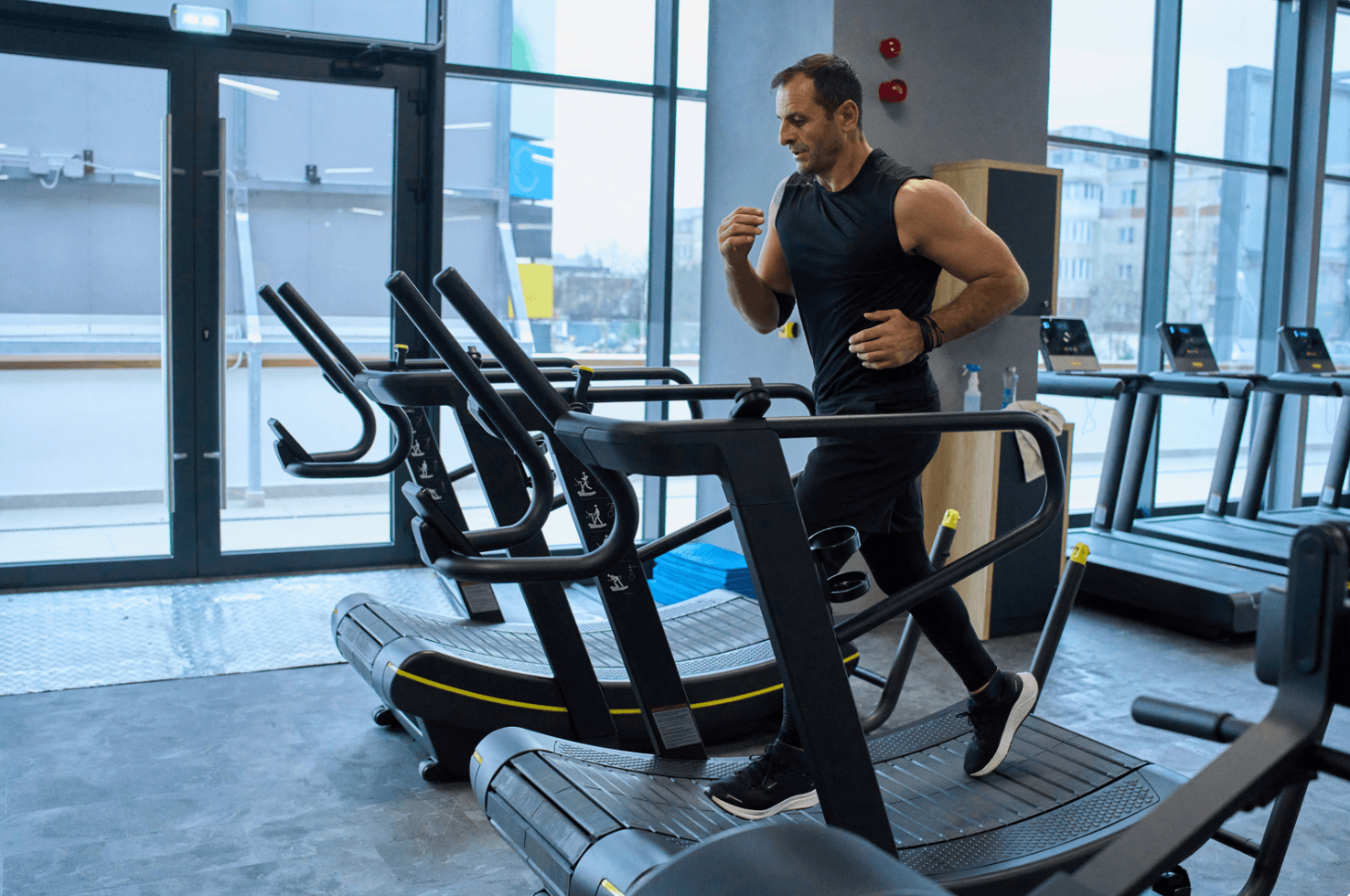
Don’t Trust Your Treadmill
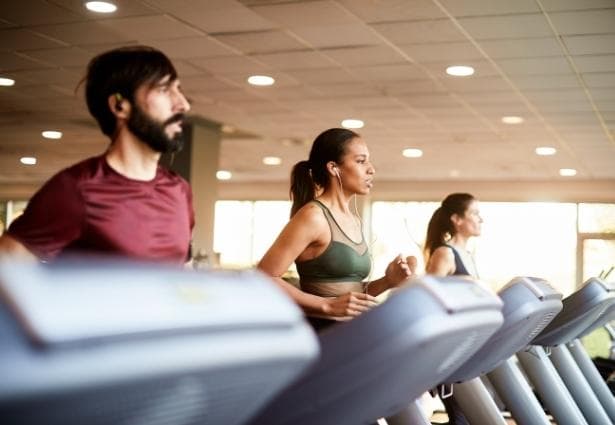
“Running” Indoors
The short version. Treadmill running is not easier. At any given pace it costs slightly less energy than running outdoors, but it feels harder, and perceived effort is what decides how fast you can go, so runners race slower on a treadmill than on a track. On top of that, most treadmills are not calibrated, so the pace on the display is not the pace you ran. Use effort, heart rate or a footpod, not the belt, to judge a treadmill run.
One of the more persistent myths in running is the idea that running on a treadmill is “easier” than running overground. Here’s a typical formulation of the myth, which I found on the website of the Houston Chronicle:
Running on a level road or trail is not the same as running on a level treadmill. The combination of a moving belt and the lack of air resistance makes a level treadmill run easier, allowing you to run at a faster pace at the same effort level. A study done in the United Kingdom found that you have to set the treadmill at a 1 percent grade in order to replicate the energy cost and speed you would run outdoors.
While it is true that, at faster speeds, the energy cost of running on a treadmill is lower than the energy cost of running overground, it is not true that this results in a lower perceived effort level on the treadmill. In fact, precisely the opposite is true. Studies have shown that running on a treadmill at any given pace feels harder than running outdoors despite the fact the cardiometabolic demand is lower.
How is this possible? It’s pretty simple, actually. Heart rate is not the only determinant of perceived effort. A variety of other factors, including psychological factors, also affect how hard it feels to run at a given pace. Indeed, a 2011 study by Brazilian, Italian, and American researchers found that overground running feels easier than treadmill running simply because it’s more fun. But I happen to think there’s another factor at play, which is the slightly greater degree of control one has when running outdoors.
When you run outdoors, your pace is never perfectly steady. Even when you’re trying to run at a perfectly steady pace, there are micro-fluctuations in rhythm, whereas on the treadmill you are locked into a rigidly unvarying rhythm. There is evidence that this lack of freedom slightly increases perceived effort. For example, a study involving rowers found that perceived effort was lower when a certain wattage was maintained voluntarily than when the same wattage was automatically enforced.
What’s more, because perceived effort has a much stronger effect on performance than heart rate does, runners are also faster outdoors than they are on the treadmill. Don’t believe me? Too bad! It’s a proven fact. In a 2014 study by researchers at the State University of Maringa in Brazil, 18 recreational runners were asked to perform one-hour time trials on a treadmill and on an outdoor track. On average, they covered 11.8 km on the treadmill and 12.2 km on the track. In other words, they performed 3.3 percent better outdoors. Yet their heart rates were lower on the treadmill.
Somebody reading this post is thinking, “Treadmill running may be harder and slower than outdoor running for most runners, but I’m an exception. I know from experience that I can run faster at a lower effort level on a treadmill than I can outside.”
The problem with this objection is that it’s based on the assumption that the speed/pace data you see on the treadmill’s information display is accurate, and this is seldom the case. Most treadmills are poorly calibrated. If you pick a treadmill at random, step onto the belt, and set the speed at 7.0 mph, you might actually be running at 6.6 mph, 6.9 mph, or 7.3 mph. I own a treadmill of reasonably high quality, and its speed readings only remain accurate for about six months after each calibration. My service plan limits me to one “free” recalibration per year, and by the time the tech comes out to my home, the speed is usually off by about 3 percent—and always in the same direction. Specifically, it’s telling me I’m running 3 percent faster than I really am. So a runner who used my treadmill in this uncalibrated state and didn’t know it needed calibrating might think that he or she is able to run faster more easily on a treadmill than outdoors.
It’s not really time but usage that causes a treadmill to lose calibration. My wife and I use our machine anywhere from three to ten hours per week. Consider how much more usage the typical fitness club treadmill gets. Unless these machines are serviced every other week or so (and most aren’t), they are likely to provide unreliable speed/pace information. You truly never know what you’re getting on a fitness club treadmill. It would be a fun experiment to go to a gym wearing a properly calibrated running accelerometer and run on five different treadmills, each set at 7.0 mph. I wouldn’t be surprised if your device gave you five different pace readings.
Conclusion
Don’t get me wrong: Treadmill running is real running. Heck, Christine Clark won the 2000 U.S. Olympic Trials Marathon after training almost exclusively on her home treadmill. But you can’t trust the speed/pace information a treadmill gives you, and even on an a well-calibrated treadmill, you can’t compare your speed or pace to your performance outdoors.
Frequently asked questions
Is running on a treadmill easier than running outside?
No. The energy cost at a given pace is a little lower indoors because there is no air resistance, but studies show the same pace feels harder on a treadmill, and runners cover less distance in a treadmill time trial than on a track.
Why does the treadmill feel harder?
Two reasons the research points to. Outdoor running is more enjoyable, which lowers perceived effort, and the belt locks you into one rhythm, while outdoors your pace fluctuates slightly from stride to stride. An enforced constant effort feels harder than the same effort chosen freely.
Should I set the treadmill to a 1 percent incline?
A 1 percent grade matches the energy cost of outdoor running at faster paces, which is where that advice comes from. It does not make the treadmill feel like the road, and it does nothing about a belt that is reading the wrong speed.
Are treadmill paces accurate?
Often not. Belt speed drifts with wear, lubrication and the runner’s weight, and gym machines are rarely recalibrated. Two treadmills set to the same speed can give you two different workouts.
How should I run 80/20 workouts on a treadmill?
Pace your easy runs by heart rate or feel and your hard segments by heart rate or running power, not by the number on the display. Set your zones with the 80/20 Zone Calculator and see the intensity guidelines for running.
Is treadmill running real running?
Yes. Christine Clark won the 2000 US Olympic Trials Marathon after training almost entirely on a home treadmill. The point of this article is only that you cannot trust the pace readout or compare it with your outdoor times.
80/20 Endurance training plans
Training for a race?
Our 5K, 10K, half marathon and marathon plans keep most of your running easy, so the hard sessions count. Four levels for each distance, from your first race to a serious time goal, with coach email support and a free switch to another level.
About the author

Matt Fitzgerald
Co-founder, 80/20 Endurance
Matt Fitzgerald is an endurance sports coach, nutritionist and the author of 80/20 Running, 80/20 Triathlon, The Endurance Diet and How Bad Do You Want It? His training plans have helped thousands of athletes of every level reach their goals.
More about Matt