How to Set a Good Race Time Goal – A Breakthrough Strategy

How to Set a Good Race Time Goal
Many of the posts I write for this blog are inspired by athlete FAQ’s. Well, this is another one. And, quite honestly, I’m note sure why it has taken me so long to write it, because it answers one of the top three most frequently asked questions I get from runners who either have read 80/20 Running or are following one of the 80/20 training plans available on this website. I’ve already let the cat out of the bag with my title, but I will go ahead and present the question anyway:
How do I choose an appropriate goal time for my upcoming race?
Race goal setting is as much an art as it is a science. There is no infallible oracle that runners can consult to obtain a time goal they can have 100 percent confidence in. But there is a way to approach goal setting that will maximize the likelihood of your coming away from the race satisfied with your performance. Here are my tips.
SO…How to Set a Good Race Time Goal without zones…
I must confess that my 80/20 training system leads many runners astray with respect to race goal setting. That’s because this system is all about intensity zones, and as such it tacitly encourages runners to look at goal setting through the prism of my seven-zone 80/20 intensity scale. But as I tell every runner (and triathlete) who asks me which zone they should target for an upcoming race of a given distance, intensity zones are too coarse an instrument to be usefully applied to the precise objective of reaching the finish line of a race in the least time possible.
For example, marathon pace for me falls within Zone X (the gap between Zones 2 and 3), as it does for many runners. When I was training for the Chicago Marathon last summer, my Zone X range was 6:13-5:50 per mile. But based on my performance in training, my coach at the time, NAZ Elite’s Ben Rosario, believed my true marathon pace was precisely 6:05 per mile. It turned out he was right. I completed Chicago in 2:39:30, which averages out to 6:05.005 per mile.
If instead of targeting 6:05 I had targeted Zone X, I might have run as slow as 6:13 per mile and finished the race in 2:42:59, disappointed in the knowledge that I could have gone faster, or I might have started the race at 5:50 per mile, blown up at mile 20, and failed to even finish.
Start with pace, not time when thinking about how to set a good race time goal
Another big mistake that runners make in setting race time goals is, well, setting race time goals. Too often runners become enamored by the idea of meeting or beating a round number or a Boston qualifying time. But these numbers are at least semi-arbitrary in the sense that, although our minds are attracted to them, or bodies do not operate by them.
There’s nothing wrong with aiming for round numbers and qualifying standards as ultimate goals, but your immediate goal for each race should be to cover the prescribed distance in the least time possible, and in approaching this goal it’s better to think in terms of pace rather than time. Ask yourself, “What is the fastest pace (either per mile or per kilometer) I can sustain over this distance?” The answer to this question should determine your time goal, not the other way around.
For example, if you believe that 6:36 per mile is the fastest pace you can sustain for 10 kilometers, then your goal time should be 41:00. The idea of “breaking 40:00” might be more attractive, but if 6:36 per mile truly is your current limit, it would be foolish to aim for that round number—yet.
Think in terms of incremental improvements.
Determining the fastest pace a runner can sustain on a given day is unknowable, even retrospectively. Therefore, the best approach to aim for a personal best in a race is to focus on improving past performances at the same distance. Comparing current training to prior training leading up to your best performance provides insight into potential speed improvements.
Rely on key workouts and “B” races when thinking about how to set a good race time goal.
Obviously, if you’re racing at an unfamiliar distance, or even if you’re racing at a distance you haven’t contested for a very long time, you can’t use the incremental-improvement approach to setting an appropriate race time goal. In this case you will need to rely instead on key workouts and on any races you do at other distances in the lead-up to your peak race. Online pace calculators can be used to generate an estimate of the time you will run at a new distance based on your performance at another distance. Be advised, though, that these calculators tend to overestimate performance at the marathon distance except in the cases of high-mileage runners (70-plus miles per week).
So when thinking about how to set a good race time goal, any sensible training program will include workouts that target the specific intensity of your peak race. This thread of the training process should culminate in a single, peak race-pace workout that serves to dial in your goal for the upcoming race. Here are suggested formats for such workouts for the four most commonly contested race distances:
5K
Warm-up
5 x 1 km @ goal pace with 200m jog recoveries
Cool-down
10K
Warm-up
6 x 1 mile @ goal pace with 200m jog recoveries
Cool-down
Half Marathon
Warm-up
8 miles @ goal pace
Cool-down
Marathon
Warm-up
16 miles @ goal pace
Cool-down
Other steps when when thinking about how to set a good race time goal:
It should go without saying, but I’ll say it anyway, that your when thinking about how to set a good race time goal you should consider not only your fitness but the specific course you’ll be racing on and the conditions you anticipate racing in. For example, if you think you’re ready to run a half marathon in 1:21:30 in perfect conditions on a flat course, but you’ll be racing on a course with two big hills in 70-degree air, you’ll want to add a couple of minutes to your expected finish time.
Calculators can’t help you much here, though. What you really need to do is adjust by feel as you go. A half-marathon goal of 1:21:30 is (or should be) based on the belief that you can sustain a pace of 6:13 per mile for 13.1 miles. So what you’ll want to do in this hypothetical example is run at the perceived effort level that is associated with this pace in ideal conditions in the less-than-ideal conditions you’ll actually be racing in. In other words, slow down just enough so that your effort feels the same.
The most important thing when thinking about How to Set a Good Race Time Goal…Don’t be afraid to make a mistake.
With pacing, as with so many other things, experience is the best teacher. No runner wants to blow his or her race with bad pacing, but there is really no better way to get your pacing right the next time. As Mark Twain famously put it, “Good judgment is the result of experience and experience the result of bad judgment.”
About the author
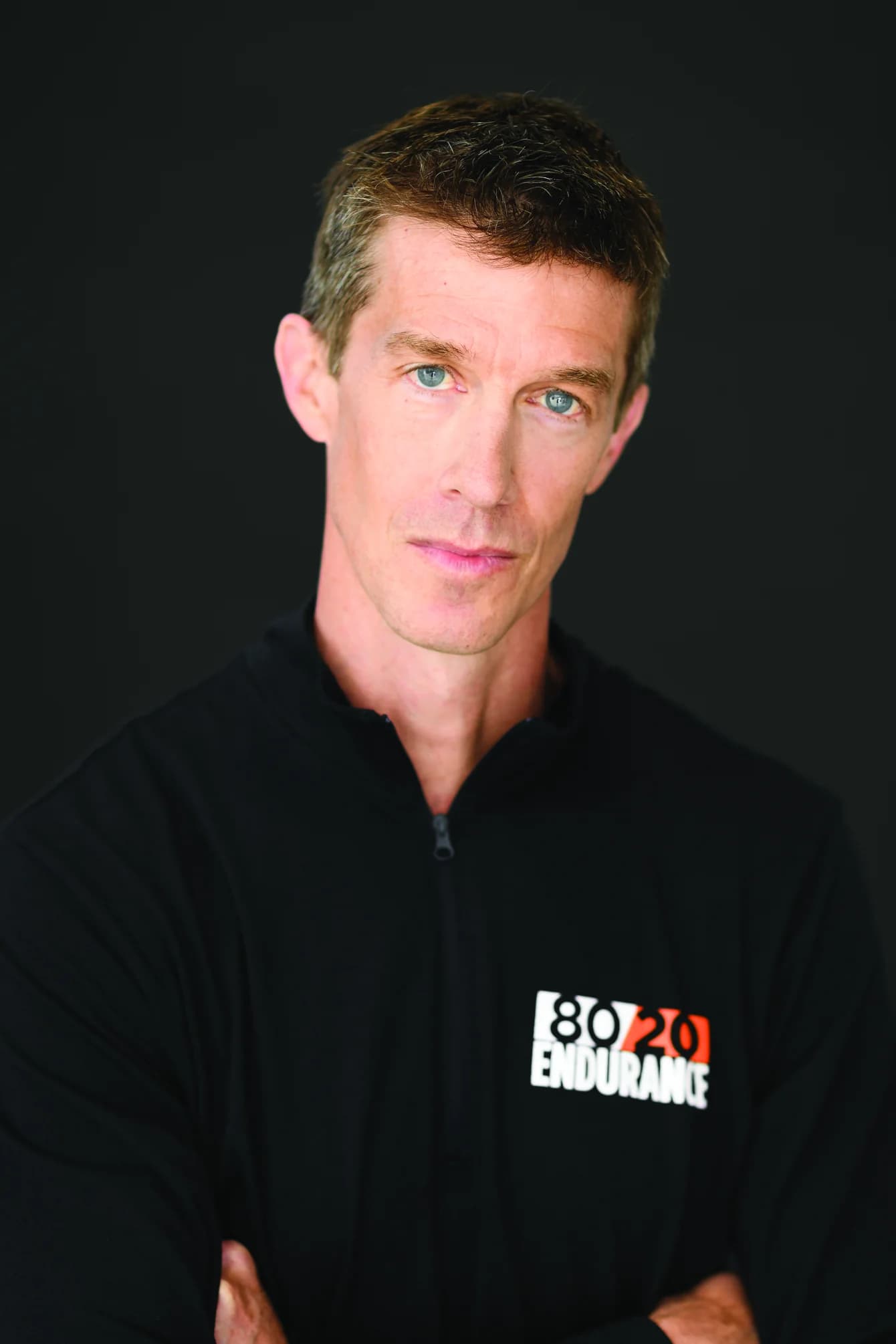
Matt Fitzgerald
Co-founder, 80/20 Endurance
Matt Fitzgerald is an endurance sports coach, nutritionist and the author of 80/20 Running, 80/20 Triathlon, The Endurance Diet and How Bad Do You Want It? His training plans have helped thousands of athletes of every level reach their goals.
More about Matt