Tapering for Endurance Athletes: A Coaches Perspective

The short version. A taper is the last 10 to 14 days before a race, when you cut training stress enough to shed fatigue but not so much that you go flat. Keep some intensity, drop volume, and aim to arrive with a Training Stress Balance of plus 10 to plus 20. Half marathoners and 70.3 athletes should see fitness, measured as CTL, drop 5 to 7 percent; marathoners and Ironman athletes closer to 10 percent. The 80/20 plans build this in.
As a coach, I have seen athletes get race prep wrong more often than they get it right. Not because they didn’t train hard, but because tapering for endurance athletes can be confusing. If you learn how to taper correctly, you can set yourself up for peak performance.
Tapering for Endurance Athletes vs. Peaking
Tapering and peaking are where the magic happens—or doesn’t. You can have a great block of training, but if you carry too much fatigue into race week, you’ll never show your true fitness. On the other hand, pull back too much, and you risk going flat. Tapering for endurance athletes is a balancing act—one that becomes far easier when you train with data.
I wrote about this in Triathlon 2.0, and it’s a philosophy I apply every day with 80/20 Endurance athletes. Especially athletes who use our TrainingPeaks Plans, where we can leverage real metrics like CTL (Chronic Training Load), ATL (Acute Training Load), and TSB (Training Stress Balance).
What I Look for in a Taper
The goal of tapering for endurance athletes isn’t just rest—it’s recovery with intent. I want to see a clear reduction in training stress, but without a sudden stop. We’re not shutting it down—we’re winding it down strategically.
I typically guide athletes toward a target TSB in the +10 to +20 range on race day. That means they’re carrying a good amount of fitness (CTL) but not dragging around high fatigue (ATL). This “freshness” number is often a better predictor of performance than CTL alone.
If you’re using one of our structured 80/20 plans in TrainingPeaks, this taper is already built in—but it helps to understand what’s happening under the hood.
For most half-marathoners and 70.3 athletes, we’re aiming for a 5–7% drop in Chronic Training Load (CTL) during the final 10–14 days. For marathoners and Ironman athletes, the drop might be closer to 10%. That’s enough to allow recovery, but not so much that fitness drops off a cliff.
This is where tapering for endurance athletes often goes wrong. They either don’t taper at all—training straight through the race—or they shut things down abruptly and lose their edge. A proper taper threads the needle.

Tapering for Endurance Athletes is Personal
One of my athletes once told me, “I don’t taper well.” What they really meant was, “I haven’t figured out what kind of taper works for me.”
Some athletes thrive on a long, gradual taper. Others come in hot and respond best to a sharper drop in volume just during the final week. Your training history, personality, and background all influence what works for tapering as an endurance athlete. A former collegiate swimmer might only need to swim once or twice during taper week to stay sharp. But a long-time runner might lose rhythm or confidence if they drop mileage too fast.
That’s why tracking outcomes matters. When you use TrainingPeaks consistently and race on structured plans, you build a library of personal data. You start to learn what taper durations, training stress balance (TSB) targets, and taper-week intensity levels translate to your best performances. That’s gold.
Common Mistakes in Tapering for Endurance Athletes
Despite good intentions, endurance athletes often sabotage their own taper. Some of the most common errors include:
- Squeezing in a final hard workout just to prove you’re still fit.
- Keeping CTL too high, afraid to lose hard-earned fitness.
- Ignoring TSB, and heading into race week with hidden fatigue.
In short, you don’t gain fitness in the taper. That work is done. What you’re doing now is unlocking it.
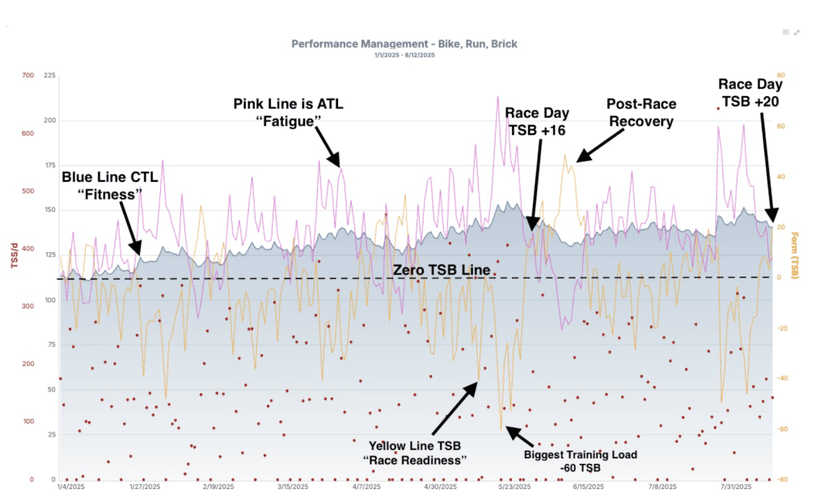
Performance Tapering for Endurance Athletes: Designing the Final Two Weeks
I always build backward from race day. What’s the TSB target? What’s the current CTL? From that, I can calculate the necessary training load reduction.
Then it’s about execution: a gradual volume reduction, a retention of intensity (usually in shorter doses), and a focus on recovery across the board—not just in training, but in sleep, stress, and mental load. This is when lifestyle matters.
Athletes on our 80/20 plans in TrainingPeaks already have this built in. But we still track and tweak. Travel schedule changed? Kids back in school? Stress higher than usual? We adjust. The plan is smart, but the context still matters.
Confidence plays a massive role in peaking. If you trust the process—and see that TSB rising into the green—you show up relaxed and ready. That alone can elevate your race-day performance.
If You Take One Thing From This…
Tapering for endurance athletes is a strategy, not a guess. It’s not just “resting more.” It’s recovering with precision based on your fitness, fatigue, and race goals.
If you’re using our plans in TrainingPeaks, you already have the structure. But I’d encourage you to start paying closer attention to the Performance Management Chart. Watch how CTL, ATL, and TSB shift in the final 10 days before your A-race. Then check back after race day: Did you perform to expectations? Were you flat? What would you change?
Over time, you’ll develop your own taper blueprint—and that’s one of the biggest assets an athlete can have.
If you want help dialing in your taper—or building your race season strategy—get matched with a coach or check out our plans with built-in tapers that work.
See you at the start line—fresh, fast, and ready.
Coach Jim Vance
Frequently asked questions
What is a taper week?
The final week or two before a race, when training volume drops so that fatigue clears while fitness stays. It is recovery with intent, not rest. You still train, you train less, and you keep a little intensity so you do not go stale.
How long should a taper be, two weeks or three?
Count in days of training load, not calendar weeks. What matters is a 5 to 7 percent CTL drop over the final 10 to 14 days for a half marathon or 70.3, and about 10 percent for a marathon or Ironman. The 80/20 plans do that in two weeks. Athletes who have found they respond to a longer, gentler taper can stretch it to three. If you are on an 80/20 plan and week 16 feels enormous, that is by design. Trust the plan.
Should I do hard workouts during the taper?
Short ones, yes. Keep the intensity and cut the volume. What you must not do is squeeze in one last long or hard session to prove you are fit. You cannot gain fitness in the taper, only lose freshness.
Will I lose fitness if I taper?
A little CTL, by design, and you gain far more freshness than you lose. Keeping CTL high out of fear is one of the most common taper mistakes.
Why do I feel flat or sluggish in taper week?
It is normal. Fatigue clears before freshness arrives, and legs often feel heavy or twitchy in the middle of the taper. Watch your TSB climb toward plus 10 to plus 20 and trust that race day feels different from day 9.
What are CTL, ATL and TSB?
TrainingPeaks metrics. CTL is chronic training load, your fitness. ATL is acute training load, your fatigue. TSB is the difference, your freshness. The Performance Management Chart article explains their limits, and every 80/20 plan comes with the taper already built.
About the author

Jim Vance
Coach and author, 80/20 Endurance
Jim Vance is an elite endurance sports coach, author and training consultant based in San Diego who coached Olympian Ben Kanute to the American record at Ironman distance and two silver medals at the 70.3 World Championships. He wrote Triathlon 2.0 and Run with Power and co-edited Triathlon Science.
More about Jim