Curved Treadmills, Why They Feel Harder and How to Run 80/20 Workouts on One
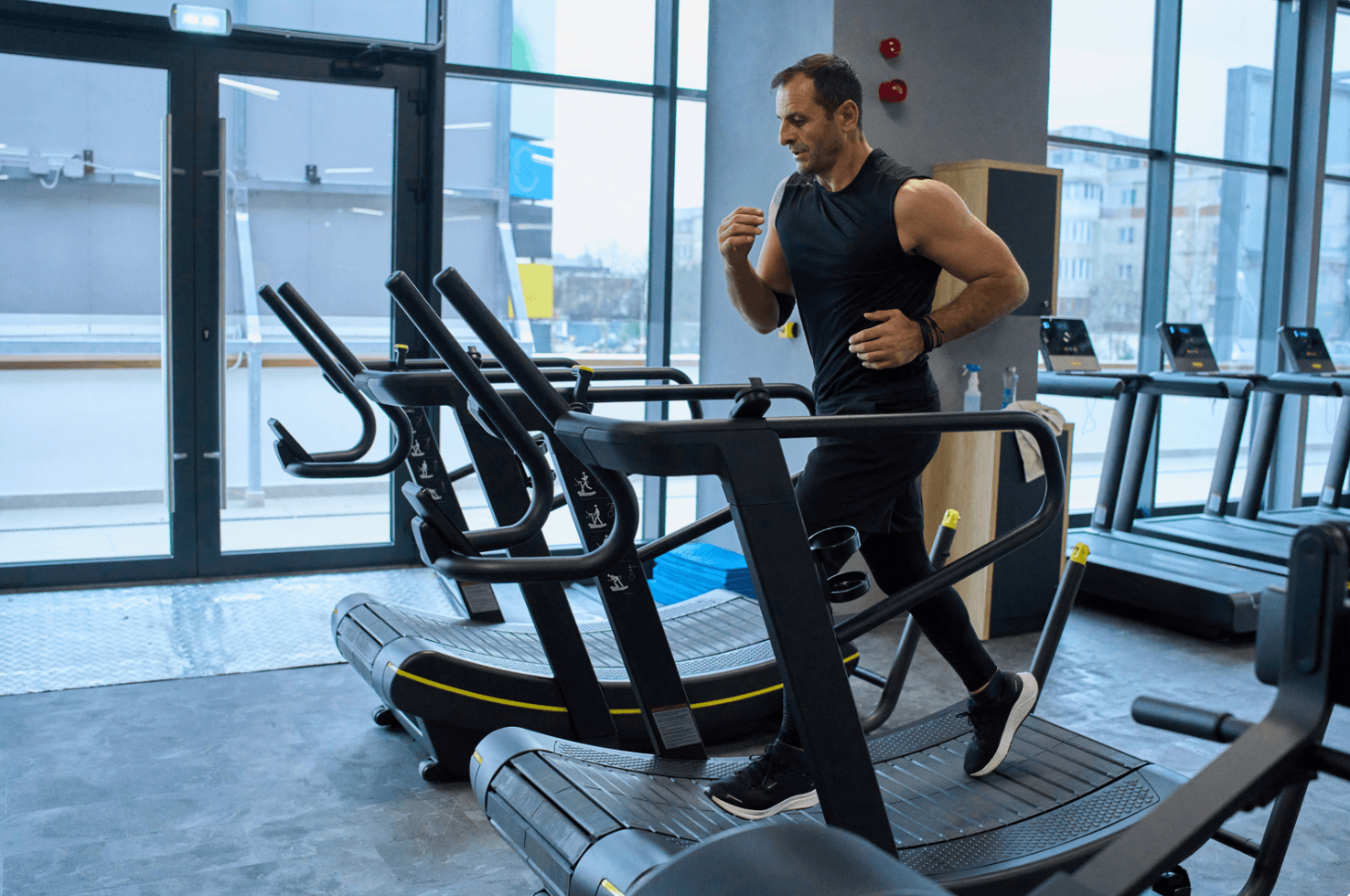
The short version. A curved treadmill has no motor. Your feet drive the belt, so the pace follows you instead of the other way round, and at any given pace it costs more than a motorized treadmill does. The published comparisons put the extra heart rate and oxygen cost at roughly a fifth to a third, which is about what a moderate uphill costs, and most runners find they are 10 to 20 percent slower at the same effort in their first weeks on one. That penalty shrinks with practice. It never fully goes away, and it does not need to. Run your easy runs by heart rate or effort, use the belt for what it is best at, which is intervals and strides, and give your calves two easy weeks before you ask for anything hard.
What a curved treadmill is
A curved treadmill, sometimes called a manual or non-motorized treadmill, is a concave belt on bearings. There is no motor and no speed button. You set the pace with your position on the curve. Step forward and up the front of the arc and gravity pulls the belt faster under you. Drift back toward the middle and it slows. Stop running and it stops. Some models add a brake or a resistance dial that makes the belt heavier to push, which turns the machine into something closer to a sled drag than a run.
Two things follow from the design. The first is that there is no incline setting, because the curve already is one. The second is that the pace on the display is the belt’s measured speed, not a motor’s claimed speed. That is more honest than most motorized treadmills manage. As we wrote in Don’t Trust Your Treadmill, the pace on a powered belt is often not the pace you ran. On a curved belt the number is real. It is just slower than you are used to.
Is a curved treadmill harder?
Yes, at a given pace. On a motorized treadmill the belt moves and you keep up with it. On a curved treadmill you move the belt, which means every stride includes the work of pushing a loop of rubber or slats over its rollers, and you do it while running slightly uphill on the front of the curve. Studies that matched speed on both machines report higher oxygen cost and heart rate on the curved belt, with the gap in the range of 20 to 30 percent. Runners tend to describe it as running up a 5 to 8 percent grade, and the gym industry is happy to repeat that, because harder sells.
What the studies do not capture is the learning curve. Our forum has a long thread on this from athletes who bought one, and the pattern is consistent. The first session feels clumsy, heart rate runs high and pace runs 15 to 20 percent slow. After a few weeks the lower legs stop complaining and the gap narrows. One of our athletes, six weeks in, found his effort for a given pace matched a powered treadmill at a 2 percent incline, which is close to what we recommend setting a powered treadmill to anyway to mimic outdoor running. So the honest answer is that a curved treadmill is harder, and it is a lot harder before it is a little harder.
Expect the extra load to land in the calves, hamstrings and glutes. The curve shortens your stride and puts you on your forefoot more than flat ground does. If you have had Achilles or calf trouble, treat your first fortnight on a curved belt the way you would treat a return from that injury. Short, easy, every other day.
Running 80/20 workouts on a curved treadmill
The most important adjustment is to stop reading pace. Your outdoor pace zones do not transfer to a curved belt, and neither do the pace zones from a motorized treadmill. If you try to hold your Zone 2 pace from the road on a curved treadmill you will be running in Zone 3 or 4, and the easy run that was supposed to be easy will not be. Every 80/20 plan is written in intensity zones that you can run by heart rate, pace or power, and on a curved treadmill heart rate is the one to use. The running intensity guidelines explain how the zones are defined and what each one should feel like.
If you want pace zones for the machine itself, earn them on the machine. Run a 20 or 30 minute time trial on the curved belt, take the average pace, and put it through the 80/20 zone calculator. Those zones are valid on that treadmill and nowhere else. Most of our athletes do not bother, and run easy days by heart rate and hard days by feel and the display.
Hard days are where a curved treadmill earns its floor space. Intervals need no button pushing. You surge by stepping forward and recover by drifting back, and the change is instant, which makes short repeats and strides far easier to execute than on a powered belt that takes ten seconds to wind up. Hill repeats are built in. The sessions that do not suit it are the ones that depend on a short, quick stride at an easy pace, such as cadence drills, because the curve wants a stride that is short and quick but also pushing, and most runners cannot hold that at low effort for long.
Two practical rules for the first two weeks. Halve the duration of whatever run you would have done on a powered treadmill, and keep it all in Zone 1 and 2 by heart rate. Then build. By week three or four most runners are doing their full easy runs on it, and by then the pace penalty has usually shrunk to something you can live with.
How to run on a curved treadmill
- Start walking. Stand in the lower third of the curve, hold the rails for the first few steps, and let the belt come to you. Let go of the rails as soon as it feels steady.
- Find the easy spot. For an easy run you stay low on the curve, with short, quick steps. If you feel yourself climbing the front of the arc, you have sped up.
- Speed up by moving forward, not by pushing harder. The front of the curve is the accelerator. Step up it to surge and drift back to recover.
- Lean from the ankles, not the waist, and keep your eyes ahead rather than on your feet. Looking down pulls you forward and speeds the belt.
- Keep your cadence up. Around 170 to 180 steps a minute feels natural on the curve and keeps you from overstriding into the front of the arc.
- Stop by walking it down. Drift back, shorten the stride, and let the belt slow with you. Do not step off a belt that is still moving.
What to look for if you are buying one
We do not sell treadmills and we do not rank them. The questions that matter when our athletes ask are these. Is the belt rubber or slats? Slat belts, the kind on Woodway and similar commercial machines, run quieter and smoother and cost a great deal more. Does it have a resistance setting, and do you want one? A resistance dial turns the treadmill into a strength tool, which is useful if you will use it that way and dead weight if you will not. How long is the running surface? Tall runners and anyone with a long stride should try before buying. How loud is it? A curved treadmill in an apartment is a conversation with the neighbors. How heavy is it and will it go through the door? Most are heavier than a powered treadmill. And what is the warranty on the bearings and belt, which are the parts that wear.
Prices at the time of writing run from about $3,000 for the home models from Assault and TrueForm to well over $10,000 for a commercial slat belt machine. A curved treadmill makes sense for someone who runs most of their hard sessions indoors, has no power outlet where the treadmill needs to go, or simply likes the feel. It makes less sense for someone who wants an incline setting, a cushioned deck for a long injury history, or pace numbers that match the road.
Frequently asked questions
Is a curved treadmill harder than a regular treadmill?
Yes. At the same pace, heart rate and oxygen cost are higher by roughly a fifth to a third, about what a moderate uphill costs, and most runners are 10 to 20 percent slower at the same effort until they have practiced on it for a few weeks.
Does a curved treadmill burn more calories?
Per mile, yes, by about the same margin that it is harder. Per minute at the same effort, no, because you run slower. A 30 minute easy run burns what a 30 minute easy run burns, on any surface.
Is a curved treadmill good for running?
It is excellent for intervals, strides and hill work, where the instant change of pace and the built-in grade help. It is fine for easy runs once your calves have adapted. It is a poor choice for cadence drills and for anyone who wants pace to match the road.
Why is my heart rate higher on a curved treadmill?
Because you are doing more work at that pace. You are pushing the belt and running on a curve, and in the first weeks you are also running inefficiently on an unfamiliar surface. The gap narrows with practice. Run by heart rate, not pace, and the problem takes care of itself.
Does a curved treadmill have an incline?
Not an adjustable one. The curve is the incline. Some models have a resistance dial that makes the belt harder to push, which is a different thing from a grade.
How should I set my zones on a curved treadmill?
Use heart rate zones from a recent field test or race, the same zones you use outdoors. If you want pace zones for the machine, run a 20 or 30 minute time trial on it and put the average pace through the zone calculator. Those pace zones belong to that treadmill only. The 80/20 plans on Team 80/20 all run by heart rate, pace or power, so the plan does not change, only the number you watch.
About the author

Jim Vance
Coach and author, 80/20 Endurance
Jim Vance is an elite endurance sports coach, author and training consultant based in San Diego who coached Olympian Ben Kanute to the American record at Ironman distance and two silver medals at the 70.3 World Championships. He wrote Triathlon 2.0 and Run with Power and co-edited Triathlon Science.
More about Jim